Week 6- Progress Report and Journal
CFA AR 892
Progress Report Worksheet
(Due Weeks 6 & 10 )
Name: Meredith Giltner
Week# /Date: Week 6/ Monday, February 26, 2024.
Please note I gave a lot of information, but I may not use all the references. This helped me organize my thoughts and thought process.
How do photos capture a journey of mindfulness, meditation and compassion for my family in a health crisis?
· How might preserving memories through photos of hundreds of miles associated with my son’s serious
health challenges contribute to personal catharsis?
How and in what ways might long-exposure photographs serve as a metaphor relating to lived experience
of dealing with a chronic illness of a child?
· How might the process of painting these photos become the key to improved health?
New Artistic & Literature findings. What is new in your research?
Artists
Emily Jeffords
Jeffords, Emily. (May/June/July 2021). The Beauty of Transformation. In Her Studio: Spaces and Stories of Creative Women, 3(4), 13-19.
In Jeffords’ article, The Beauty of Transformation, she explains how she primarily paints landscapes. She even mixes her watercolor paint from minerals to get the perfect color. I find them intimidating. I love taking pictures of landscapes, but painting them would take time I do not have. I love that Jeffords’, despite having three kids, finds time to create in her dedicated studio space as well as at home. She also invites her children to help and collaborate. I agree that you do not have to be in a specific space to create; I tend to do it everywhere and anywhere I can. Jeffords also feels the process of having a creative practice is essential for growth and believes “progress over perfection” (p. 13) and “inward” (p. 19) creativity is vital to stay true to her artist way. My favorite quote:
Creativity and inspiration are two of the most generous friends you or I will ever know. They don’t need much to get going. They fill your heart and mind with the best, truest parts of yourself. They filter the world around you through a specific lens. They heal the wounds we are not aware of, fixing things that feel out of alignment or a little dusty and stale. (p. 19)
My thought after researching other artists is that many follow a practice in which they capture a personalized view of the landscape based on an emotional response to it rather than to achieve a naturalistic representation. I find this encouraging. I'm still struggling with how many paintings or images to do and the aesthetics of the style. I am unsure about the still photos, but my son thinks he likes the stills the best. See notes at the end.
Millie Tibbs
Her work is abstracted landscapes in which geometric shapes are made within her landscapes, and she folds or embroiders her images to show dimensionality. I saw her work in person; you will see her influence in my new pieces.
”Despite our awareness of the mutability of photographic images, we approach them thinking we know what to expect: something that-has-been, a fixed subject inside a frame. I am drawn to photography because of its ubiquitous presence in our culture and because of the tension between the truth-value photographs infer and their inherent manipulation of reality. I develop my work out of my desire to scratch off the surface of the image and expose its construction.”
George, D. (2018, August 15). Photographers on Photographers: Daniel George on Millee TIbbs - LENSCRATCH. LENSCRATCH. Retrieved February 12, 2024, https://lenscratch.com/2018/08/photographers-on-photographers-daniel-george-on-millee-tibbs/
Emily Carr
The Group of Seven. (2019, August 28). Emily Carr — the group of seven. Retrieved February 23, 2024, from https://thegroupofseven.ca/emily-carr/#:~:text=Emily%20Carr%20was%20a%20Canadian,until%20late%20in%20her%20life
Helen Frankenthaler
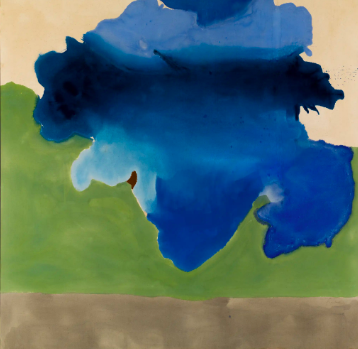
The Bay, 1963, Helen Frankenthaler, American, 1928-2011
Acrylic on canvas
Unframed: 80 3/8 × 82 1/8 × 7/8 inches (204.2 × 208.6 × 2.2 cm)
81 3/4 × 83 3/4 × 1 3/8 inches (207.6 × 212.7 × 3.5 cm)
Young, P. (1995). Instructional Resources: The Abstract Landscape of Expressionism: Detroit Institute of Art. Art Education, 48(1), 25–52. https://doi.org/10.2307/3193558
On the process of painting and meditation
When you are in the studio painting, there are lots of people in there with you- your teachers, friends, painted from history, critics … and one by one, if you’re really painting, they walk out, and if you are really painting, you walk out. – Philip Guston, ART2LIFE.
Art2Life - Nicholas Wilton. (2023, April 14). About | Art2Life - Nicholas Wilton. Art2Life - Nicholas Wilton | Create Reveal Transform. Retrieved February 12, 2024, https://www.art2life.com/statement/
Aesthetics
Aesthetic debates within contemporary art have been tangential to the debates in environmental aesthetics since the 1960s. I argue that these disciplines, having evolved separately in response to the limitations of traditional aesthetics, may now usefully inform each other. Firstly, the dematerialisation of art as the focus of aesthetic experience may have environmentally useful consequences. Secondly, Gablik's 'connective aesthetics', like Berleant's 'aesthetics of engagement', folds aesthetic experience into the social as a kind of environmental aesthetics. Thirdly, contemporary art's flexible readings of 'framing' can respond to 'frameless' natural environments, and finally, Kester's 'dialogical aesthetics' may be enriched by Berleant's systematic account of 'contextual aesthetics'.
Reviewed Work(s): Environmental Aesthetics: Crossing Divides and Breaking Ground by Martin Drenthen and Josef Keulartz Review by: EWAN J. WOODLEY Source: Environment and History, Vol. 22, No. 1 (February 2016), pp. 148-150 Published by: White Horse Press
Art Therapy
I wanted to make sure that this process would be one of healing and I thought deeply about the practices I use in my classroom. I know I had a san culpa or intention each time we traveled of wanting my son to be healthy, happy and feel loved. However, I found Guzman’s lessons and explanations of why landscapes as a therapy to be helpful in my quest.
Emotional Landscapes- p. 25, A daily or weekly task that explores the current emotional state of the creator. Questions for discussion are: Does your painting speak to the emotions you’re feeling at the moment? How long have you been feeling this way? Is there a message in your painting?
Visual Metaphor of Your Life- p. 36, A windy day or a calm stream. Questions for discussion are: What emotions surface while painting? What feelings are associated with your current experiences in life?
Manipulating Photos- p. 68, Using a portrait with landscape make a double exposure. Questions for discussion are: How do you relate to the combined images? What feelings did the images evoke separately? What feelings do they evoke now that they are combined?
Guzman, L. (2020). Essential art therapy exercises: Effective Techniques to Manage Anxiety, Depression, and PTSD. Rockridge Press.
Other Resources:
Smits, K. W. (2009). The use of colour and shape to enhance mood in landscape painting, from the turn of the 20th century, and its contemporary applications. Retrieved February 7, 2024: unsworks.unsw.edu.au. https://doi.org/10.26190/unsworks/23207
Potter JD, Brooks C, Donovan G, Cunningham C, Douwes J. A perspective on green, blue, and grey spaces, biodiversity, microbiota, and human health. Sci Total Environ. 2023 Sep 20;892:164772. doi: 10.1016/j.scitotenv.2023.164772. Epub 2023 Jun 10. PMID: 37308017.
Therapeutic Landscape
The metaphorical concept of ‘therapeutic landscape’ brings together the notion of landscape with principles of holistic health, and has been applied to a wide range of contexts to investigate how environmental, societal and individual factors ‘interact to bring about healing in specific places’ (Gesler: 735). The concept, as it is operationalised in human geography and related disciplines, was originally championed by geographer Wilbert M. Gesler in the early 1990s, defined as a particular setting that has ‘an enduring reputation for achieving physical, mental and spiritual healing’ (1993: 171). The therapeutic landscape metaphor remains, now nearly three decades later, one of the key ways to engage directly with the geographical situatedness of health-related knowledges and practices, and the concept has inspired a rich debate that has reached beyond the disciplinary boundaries of health and cultural geography, and is continuing to evolve. This chapter highlights how landscape, and the relatednotions of place and space, have been operationalised in the study of health processes. It will do so by sketching out the development of the now substantial literature on therapeutic landscapes through three (necessarily overlapping) ‘moments’ in its history: (1) landscape as a framework for the study of health in place; (2) the conceptual expansion that took place during a second ‘phase’ in its history of development; and finally (3) avenues for future work on landscapes of well-being. Each substantive section will cover the key aspects of the developmental history of the concept.
Doughty, Karolina. (2018). Therapeutic Landscapes. 10.4324/9781315195063-27.
Other resources:
Sutton, J., PhD. (2023, September 22). Mindful Photography: 11 therapeutic Ways to Use your camera. PositivePsychology.com. https://positivepsychology.com/mindful-photography/
Yale University Press. (2022, April 12). Meditation and photography. https://yalebooks.yale.edu/2018/03/10/meditation-and-photography/
Brott-Holtzman, E. (2022, January 21). How to start a meditative painting practice. Spirituality+Health. https://www.spiritualityhealth.com/meditative-painting
Mindset, Meditation, and Mindfulness
I will use the following resources to sustain my artwork and why I created it. It may not seem apparent why right away, but it is the core of who I am and what I had to become in order to weather this storm with my son. I cannot separate the practice I had to start doing with my son and my art, specifically examining the advantages of understanding different mindsets, meditations, and mindfulness for myself and my family. I tend to make more art when I am stressed. I am also an avid researcher and reader, which is a practice that helps me sustain my art- photography and painting. They also influence me and at times, what I read shares a thread with my own story that I felt so isolated. I feel strongly that I can’t change others or control circumstances, but I can work on myself, which benefits everyone around me.
Mindset
Dweck, C. S. (2007). Mindset: The New Psychology of Success. Ballantine Books.
This book explores the concept of mindset and how it affects one's approach to learning, challenges, and life. Dweck explores ten topics for success. They are the importance of a growth mindset, the dangers of a fixed mindset, the power of praise, the impact of feedback, the role of education, the importance of perseverance, the benefits of a learning orientation, the value of hard work, the power of self-belief, and the potential for change. I read this book not only for school but also because I was struggling with how my son’s medical care was not helpful and harmful in many ways. He was told his pain was in his head, and when offered psychological services for the first time, he was told that most teenage boys, especially athletes (my son played travel hockey up to this point), do not participate in therapy and his social service interview ended when the social worker asked him why he thought he could go to Skyline High School when he lived in Dexter. My son would be a school-of-choice student at Skyline HS, where I teach. I realized at this point of his journey that I could not change others, but I could change myself. After that, we left the University of Michigan Children’s Hospital and found Beaumont Hospital, forty-five minutes away in Michigan, and Cincinnati Children’s Pain Clinic, four hours away (we just left in January for Cleveland, which is three hours away).
The below phrases resonated with me as I often see this with my students and I saw it with my son. Before my son got sick, he was in advanced math and had done 6th, 7th, and 8th grade math in one year during the lockdown. He was motivated, but the following year, the school changed platforms, and he had to redo the 7th and 8th-grade math in 3 months to continue with Algebra in 8th grade. He was frustrated, and it took a physical toll on him.
“Praising children's intelligence harms their motivation, and it harms their performance.” (p. 221)
“Beware of success. It can knock you into a fixed mindset.” (p. 266)
Meditation as a Personal Practice
I had become a meditation practice of Yoga Nidra in 2019 when my shoulder locked up after a car accident. Stress was affecting my body. I needed more sleep, and I needed to set a san culpa or intention each week. I worked with Susan Whitmarsh and even brought the practice to all the art teachers in Ann Arbor Public Schools for professional development. This would become the inspiration to delve deeper into meditation while my son’s illness and chronic pain became too much. Susan has become an invaluable resource, but due to schedule conflicts, I have not been able to make the session since they are on Thursdays from 7:30 to 8:30 pm. I also started meditating with this group and split my time between Breathe Yoga Studio and the Ann Arbor Zen Temple. I did make artwork during this time.
Susan’s Recording of a Yoga Nidra session can be found at https://www.breatheyogachelsea.com/blog/yoga-nidra
Breathe Yoga Studio. (2020, March 23). Yoga Nidra with Sue Whitmarsh — Breathe Yoga Chelsea. Breathe Yoga Chelsea. Retrieved February 22, 2024, from https://www.breatheyogachelsea.com/blog/yoga-nidra
Ann Arbor Zen Temple
My meditation journey started with the Zen Temple in January 2023. I was looking for a way to get centered and to see outside of the big picture with my son since I had hyper-focused my efforts and attention on him getting better and being well, but he needed space, and I needed to calm down. I found the large group intimidating, and I was nervous to go in because of COVID-19, as the leader had recently passed away from COVID-19. Ann Arbor, in general, does not do vaccinations. I chose to do the online version and was met with a small group from around the world who asked questions and acknowledged each other. I felt this was a better match. I did this for about 8 months, and I forgot about it. But I use many of the meditation techniques, like being here now in the moment, and the hardest one is that suffering is part of life, which is so unfair to think that any child should suffer.
Ann Arbor Zen Buddhist Temple. (n.d.). Zen Buddhist Temple. Retrieved February 22, 2024, from https://www.zenbuddhisttemple.org/annarbor and https://www.zenbuddhisttemple.org/online-sangha
My meditation journey began in 2019, but I continue to look further into the four noble truths, precisely the path of no suffering, to the noble eightfold path. I think this is where I want to look at my photographs and reflect on which part of the path each photo was a part of if that works. The graphic organizer below really helped me articulate the stages of meditation I went through. I usually put a word on the back of my artwork to remember how I was feeling or the san culpa or intention I was trying to achieve.
Meditation and a Graphic Organizer for 4 Noble Truths and the Eightfold Path
https://expertlearners.com/GO_Buddhism.php
Just a note: I do a daily meditation with Jay Shetty on the Calm app, I do tapping or Emotion Freedom Technique as needed, I speak with my friends (many are therapists), and I exercise as part of my meditative ritual. I also watch the Sunday church service that streams from my childhood church, St. Mary’s Our Lady of the Snows. I went to church religiously until I started college and remember using that time as a meditation, which helped me get through high school.
EFT/Tapping and Meditation
https://www.thetappingsolution.com/blog/what-mindfulness-meditation-and-eft-have-in-common/
Ortner, N. (2021, June 21). What mindfulness meditation and EFT tapping have in common. The Tapping Solution. Retrieved February 22, 2024, from https://www.thetappingsolution.com/blog/what-mindfulness-meditation-and-eft-have-in-common/
Mindfulness as a Practice
Mindfulness to me is recognizing that your body, feeling, and mind are one with Dhamma or natural order. It is often used with the meditation techniques of silence to clear the mind and or breathing to center or calm oneself. Mindfulness generally has a goal that is preset or a lesson to be taught in a secular setting like school or on social media. I think of mindfulness as something tangible and can be viewed through actions (which can be art), while meditation is more inward.
Mindfulness
As I sort my long exposure photos and try to work through the stages
“Amidst the burgeoning enthusiasm for mindfulness in the West, there is a concern that the largely secular 'de-contextualized' way in which it is being harnessed is denuding it of its potential to improve health and well-being. As such, efforts are underway to 're-contextualize' mindfulness, explicitly drawing on the wider framework of Buddhist ideas and practices in which it was initially developed. This paper aims to contribute to this, doing so by focusing on Zen Buddhism, and in particular on Zen aesthetic principles. The article concentrates on the seven principles identified by Hisamatsu (1971) in his classic text Zen and the Fine Arts: kanso (simplicity); fukinsei (asymmetry); koko (austere sublimity); shizen (naturalness); daisuzoku (freedom from routine); sei-jaku (tranquillity); and yūgen (profound grace). The presence of these principles in works of art is seen as reflecting and communicating insights that are central to Buddhism, such as non-attachment. Moreover, these principles do not only apply to the creation and appreciation of art, but have clear applications for treating health-related issues, and improving quality of life more generally. This paper makes the case that embodying these principles in their lives can help people enhance their psychosomatic well-being, and come to a truer understanding of the essence of mindful living.”
Review: Re-Viewing Landscape
Reviewed Works: Impressionism and the Modern Landscape. Productivity, Technology and Urbanization from Manet to Van Gogh by James H. Rubin; Landscape and Vision in Nineteenth-Century Britain and France by Michael Charlesworth
Review by: Simon Kelly
Oxford Art Journal, Vol. 32, No. 2 (2009), pp. 316-321 (6 pages)
Meditation and Mindfulness
In the book Why We Meditate, Goleman and Rinpoche offer a dual perspective on meditation. The authors successfully synthesize their ideas and viewpoints, demonstrating their shared interest in science and extensive meditation experiences. The text is a smooth, interwoven narrative of science, religion, and poetry, and each chapter begins with a discourse on various aspects of Buddhist meditation practice by Rinpoche, followed by a discussion of the relevant scientific research by Goleman.
WHY WE MEDITATE | Kirkus Reviews. (n.d.). Kirkus Reviews. Retrieved February 22, 2024, from https://www.kirkusreviews.com/book-reviews/daniel-goleman/why-we-meditate/
I chose this book because I wanted to see how it might impact my relationship with my son. I found I was so tired and frustrated that there were times when it felt like everything we tried made it worse or we just weren’t seeing the results we wanted, and instead, they kept giving us more medicine, but my son was worse when we upped his meds and refused to take them starting in January of 2023. We were told we needed to be firm with him, but we trusted him, and although we were able to unpack what he had starting in June of 2023 with the thought he might have MALS based on his symptoms, we had to fight hard to get him on the other side with surgery and recovery that would make him miss more school. Between June of 2023 and January 2024, I would say that my practice of journaling and making art kept me from overreacting when my son said he was in pain or looked like he was in pain.
Other Resources:
Amaro, A. A Holistic Mindfulness. Mindfulness 6, 63–73 (2015). Retrieved February 22, 2024, from https://doi.org/10.1007/s12671-014-0382-3
Bodhi, B. (2010). The noble eightfold path: The way to the end of suffering. Buddhist Publication Society. https://books.google.com/books?hl=en&lr=&id=--vzVMVPHJMC&oi=fnd&pg=PR7&ots=U4nraBV8BQ&sig=3JOIrzm-4vcNOsN-9kVxvPFPgHM#v=onepage&q&f=false
Lomas, T., Etcoff, N., Van Gordon, W., & Shonin, E. (2017). Zen and the Art of Living Mindfully: The Health-Enhancing Potential of Zen Aesthetics. Journal of Religion and Health, 56(5), 1720–1739. http://www.jstor.org/stable/26749157
https://mindowl.org/what-are-the-four-foundations-of-mindfulness/
Bastos, F. (2023, December 28). What are the four foundations of mindfulness? Exploring the essence of mindful contemplation - MindOwl. MindOwl. https://mindowl.org/what-are-the-four-foundations-of-mindfulness/
Body, Feelings, Mind, Dhamma
Bodhipaksa. (2023, May 18). The four foundations of mindfulness as a dynamic process. Wildmind. https://www.wildmind.org/blogs/on-practice/the-four-foundations-of-mindfulness-as-a-dynamic-process
Upload (separately or embedded in a PDF) video, photos, audio, etc. of your artwork in progress. Upload anything that brings us in your studio/virtual workspace. If using images in .jpeg create an audio file (or text) explaining what you have been working on.


Summary. Briefly write about the areas that are developing well, how you are thinking about situating your work, what is on the check list of what is planned for next week, and areas that need effort and support.
To be honest, I am really torn between the stills, long exposure, paintings, and embroidered images. Each technique seems to mean something different. Is it possible to do more than one style? Could I do a set in each: long exposure, painting, and embroidery? Do I use a different technique for different parts of our journey?
I am taking an online course from Domestika- Introduction to Photo Embroidery: Create Images with Texture. A course by Ofelia & Antelmo, Textile Art Workshop.
Introduction to Photo Embroidery: Create Images with Texture. (2022, January 20).
[Video]. Domestika.
https://www.domestika.org/en/courses/2988-introduction-to-photo-embroidery-create-i
ages-with-texture?fbclid=IwAR1JxousGzOriboA2fUEb49eOfJEiMUJQVifJLtouXsm2T
BX4Z5tt2OSPE&utm_campaign=0_US_PROS_COURSES_i18n_Catalog&utm_content=campaignid_120204769590340203_adid_120204769590380203&utm_medium=cpc&utm_source=facebook.com
Discussion with Dorian (my son) 2.25.24
I wanted to get my son’s opinion on the larger pieces I had printed and the orientation of the pieces. I had not planned to ask him, but the pictures were out, and I took a chance.
He didn’t care for clouds but preferred the one on the left. These were taken after a trip to see his paternal grandma so they could spend time together and maybe take his mind off his pain. Unfortunately, she lives 3 hours away, which was uncomfortable for him. I took the photo from the backseat of the car. The aesthetics and composition of the piece filled me with hope despite the overall frustrating situation.
He liked the second set, which was taken after we met with the surgeon post-surgery 2 weeks ago. We were coming home and there was a lake that we were passing. He preferred the one on the left. He asked me who took the photos, and I said I did. He shrugged and said they were good but didn’t like the clouds as much.
He asked me why I was asking him about them, and I explained that I had taken them on our trips from the backseat ever since they said they wouldn’t stop, so I was experimenting with long exposures.
I next showed him the photos from the weekend before when he said he felt better and wanted to return to school. I explained where I took them and why I embroidered them. He said I distorted it too much. The stills would have been better.
Today, in the car, I saw Dorian looking out the window while we drove to my mom’s birthday dinner. My son and mom have a bond as they both have Crohn’s, and my mom takes nerve pain medicine. She had an accident this summer (July 21, 2023) after Summer Studio in which she broke her neck, collar bone, eye socket, and other things from falling at the bottom of the stairs. She spent three weeks in ICU, four weeks in Traumatic Brain Injury Rehab, and 7 weeks in regular Rehab. Dorian could see what I was doing with the long exposures. The passing of time and place. I think that pain is a place for him.
My husband likes all of the images in every variation but liked the ones above the clouds the most.

List for Week 7:
Paint some landscapes.
Consider taking a class online class for landscape painting- https://www.domestika.org/en/courses/4221-landscape-oil-painting-with-plein-air-techniques/course
Complete Embroidery Class
https://www.domestika.org/en/courses/2988-introduction-to-photo-embroidery-create-images-with-texture/units/12800-introduction



Comments
Post a Comment